CDK Unify
CDK Unify puts every CDK app behind one login. It started as a 3 week concept sprint and became the platform behind CDK's move to SaaS.
One platform
Dozens of separate products brought behind a single sign-on.
Built around roles
Each person sees the apps and workflows for the job they do.
A new strategy
The foundation for CDK's move to SaaS.
Still growing
Used by 150,000+ dealership employees, with Unify 2.0 in development.
Dozens of products, dozens of logins
Over decades, CDK had built dozens of products, each with its own login, portal and look. A dealership employee could need three or four logins just to get through the morning. Leadership brought the design team three questions and no brief: how do we get every app behind one sign-on, how do we share data across them, and how do we become a true SaaS company?
A portal and password per product, each with its own design.
Unify · one sign-in
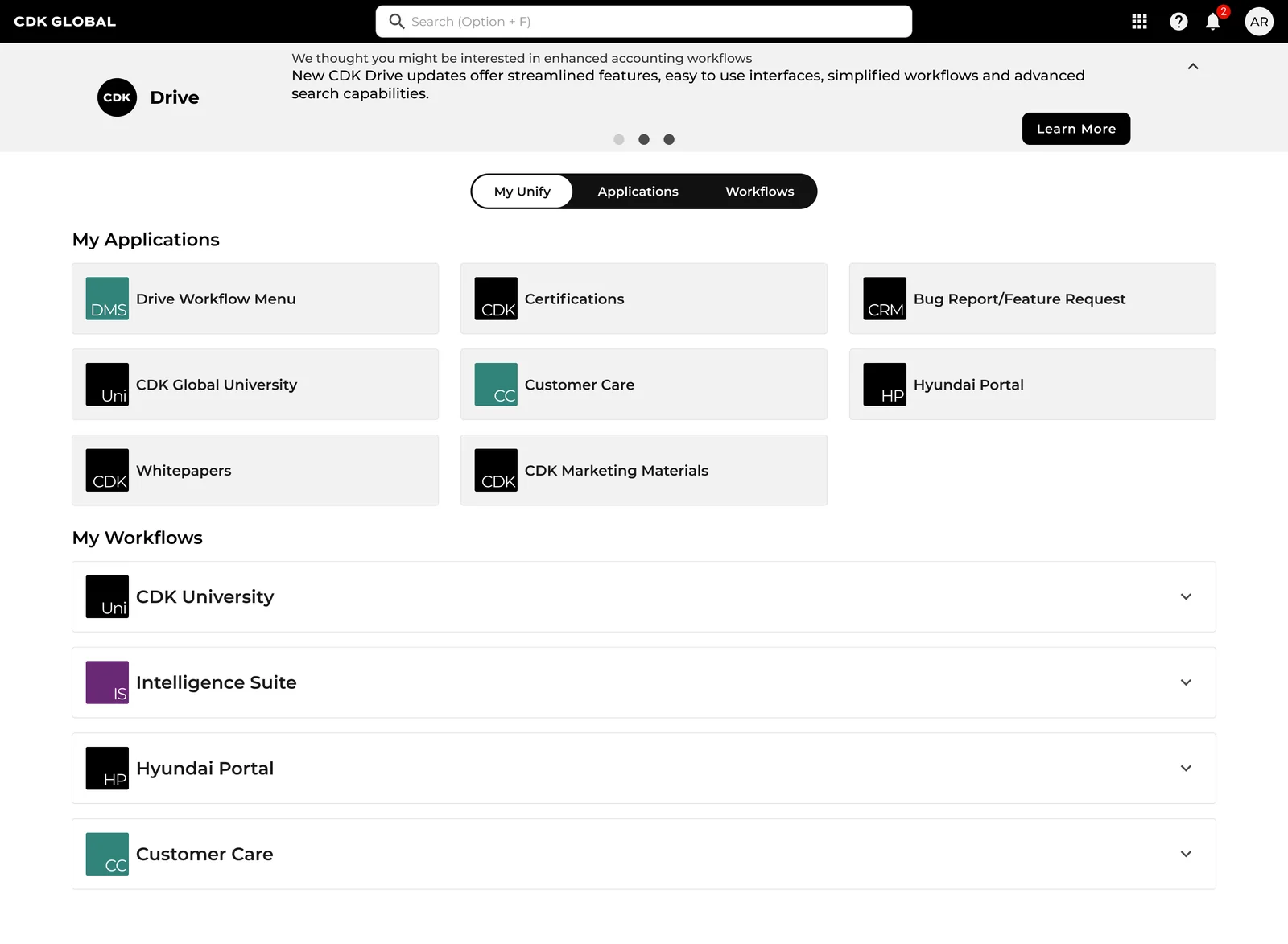
One platform, with each role's apps waiting on the home screen.
From blank slate to executive approval in 3 weeks
We treated it as an internal hackathon and kept the stakes low on purpose.
Workshop and shared system.
I ran an ideation workshop with designers and engineers, then we built in Figma on a shared, just-in-time design system.
First leadership review.
The feedback was "too many ideas." We cut to the core features, fast, because everything shared one system.
Executive approval.
The refined prototype went to CDK's Chief Product and Technology Officer and became a real project.
Public debut.
Unify was introduced to dealers at the largest auto retail show in the US, and their feedback fed straight back into the design.
A home built around each role
I was one of the lead designers from the first workshop through launch, and kept designing for the platform until 2025. The biggest decision I made was a role-based home.
Role-based home
Before, everyone landed on the same generic portal and had to hunt for their tools. In Unify, a service advisor, a finance manager and a general manager each see a different set of apps, data and workflows, tailored to how they actually work.
Why it mattered: it gave every new app that joined Unify a clear place to live.
Workshop facilitation
Led the cross-functional workshop that set the feature set and personas.
UX architecture
Defined the role model, navigation and core patterns the platform still runs on.
Long-term ownership
Onboarded product teams and evolved the platform for years after launch.
Where it got hard
Many apps, one shell
Once every product lived in the same frame, their inconsistencies were impossible to ignore. That kicked off CDK's UI harmonization effort, which I also led, with Radial as the shared foundation.
Old and new tech side by side
Apps ran on everything from modern frameworks to legacy systems. Each onboarding was its own negotiation, and the shell had to flex without sinking to the lowest common denominator.
Years of muscle memory
Dealership staff knew their old portals by heart.
Where Unify is today
Unify is now a core part of CDK's market strategy, and much of the company's move to SaaS is credited to it. It's used by 150,000+ dealership employees, every new and modernized app is required to live inside it, and Unify 2.0 is in development.